Crew Neck or V-Neck: Choosing a Collar Shape
Crew neck or V-neck? Compare how each neckline frames the face and works with shirts, jackets, and jewelry to choose a shape that suits your wardrobe.
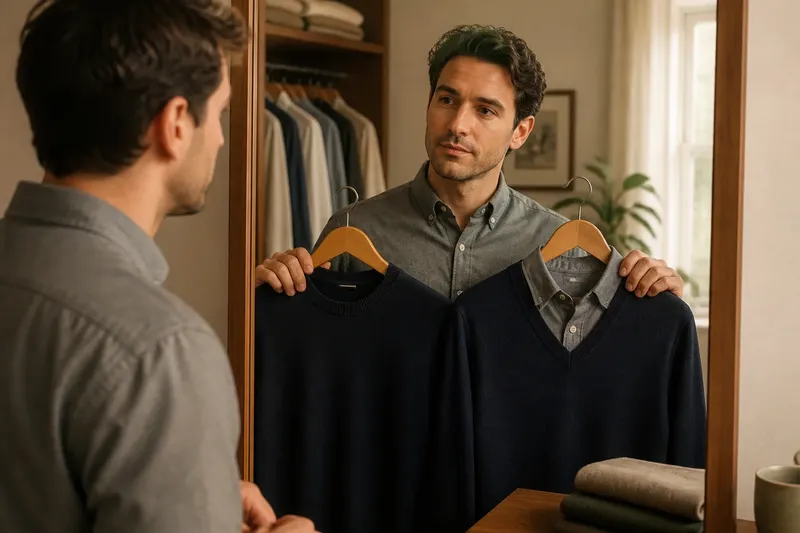
Crew neck or V-neck? The difference shows up most clearly at the face and at the edge of a layer. A crew neck gives the upper chest a closed, rounded frame; a V-neck leaves a wedge of space below the throat. Neither shape is a correction for the body wearing it. The useful question is which one suits the clothes you already reach for.
How the neckline frames
A crew neck traces a curve around the base of the neck. Its raised edge can make a plain T-shirt feel finished on its own, and it gives a sweater a compact, familiar outline. The neckband matters: a narrow band reads quietly, while a thick ribbed band draws more attention to the collar itself.
A V-neck directs the eye downward along two diagonal edges. A shallow V can look nearly as restrained as a crew, while a deeper opening gives more room for a shirt collar, pendant, or visible undershirt. The angle can make the chest area feel more open, but the garment’s cut and fabric still matter. A loose, drapey V does not behave like a close-fitting one.
Try comparing both shapes with the same jacket and trousers. The neckline is a small detail, but it works like a picture frame: it changes the view without changing what is inside it. A crew often puts the emphasis on the garment’s surface; a V can give the face and any layer beneath it more visual room.
Layers that cooperate
A crew-neck T-shirt is an easy partner for an open button-down, denim jacket, or cardigan. Its edge stays visible as a simple curve, and it avoids competing with a shirt collar. Under a crew-neck sweater, a collared shirt can work if the collar points sit neatly beneath the knit. If they bunch or spring outward, the pairing looks fussy rather than deliberate.
A V-neck sweater is made for a collared shirt when the V is wide and deep enough to show the collar without pinching it. The shirt’s top button can stay fastened for a tidy arrangement, or remain open for a softer one. A V-neck T-shirt can also sit beneath an open overshirt, though a deep cut may reveal more undershirt than intended when the top layer shifts.
Consider the whole opening, not just the label on the garment. A jacket with a narrow lapel, a shirt with a broad collar, and a shallow V may crowd one another. A crew can simplify that combination. By contrast, a plain V-neck under an open jacket can leave a clean line down the center without adding another collar to manage.
Choosing a neckline?
Does a crew neck suit a long face?
A crew neck can create a horizontal curve near the base of the neck, which some people prefer for its compact effect. It is a styling choice, not a rule about face shape. Compare the garment in a full-length mirror with the same hairstyle and outer layer you would normally wear.
Should a V-neck show an undershirt?
Only if that is the look you want. A V-neck undershirt can remain hidden beneath a shallow V, while a crew-neck undershirt may appear at the opening. Check while sitting and moving, since the neckline can shift during ordinary wear.
Which shape works with a collared shirt?
A V-neck sweater usually gives a shirt collar clearer space, provided its opening is broad enough. A crew-neck sweater can also work when the collar is small and lies flat. If the points bunch under the knit, choose a different shirt or neckline rather than trying to force the layers into place.
Can you wear a necklace with either shape?
Yes. A short chain can sit above a crew-neck edge, while a pendant may follow the open space of a V-neck. Check where the chain rests against the fabric; a pendant that catches on a knit or lands awkwardly near the V’s point may be better with another top.
Fit and fabric details
The neckline should lie flat without pressing into the throat or gaping away from the chest. On a crew neck, inspect the band for waviness and see whether it holds its shape after the garment is on. On a V-neck, look at the point: a neat, stable seam helps the opening keep its intended angle, while a stretched point can make the front appear uneven.
Fabric changes the impression. A firm cotton jersey makes a crew neck look crisp; a soft knit lets it relax. The same applies to a V-neck, where a fluid fabric can deepen the apparent opening. Ribbing, seam construction, and laundering instructions affect how an edge sits, so check the care label and follow the maker’s directions.
Say you are choosing between two navy sweaters for the same gray collared shirt. One has a close crew neck that presses the shirt collar flat; the other has a moderate V that leaves the collar points visible. If the shirt is part of the outfit rather than just an underlayer, the second sweater is the more coherent choice. If you plan to wear the sweater alone, the crew may feel more complete.
Make the closet decide
Before buying, think of three pieces you would actually wear with the top. Include an outer layer, because a neckline that looks good alone may disappear beneath a high collar or collide with a lapel. If the garment only works with a special shirt you rarely wear, that is useful information.
- Check whether the opening sits comfortably when you turn your head.
- Look at the neckline with the jacket or cardigan you wear most often.
- Notice whether a shirt collar lies flat beneath it or bunches at the edges.
- Decide whether you want an undershirt or necklace to remain visible.
- Compare the garment both standing and seated, when fabric can shift.
There is no need to choose one shape for every outfit. A crew neck is often the straightforward option for a simple standalone top or a clean layer beneath an open shirt. A V-neck can make a collared shirt or pendant part of the composition. For crew neck or V-neck, the best choice is the one that sits comfortably and gives the rest of the outfit the amount of attention you intend.