How to Match Accessories Without Making Them a Set
Learn how to match accessories through color, finish, and scale, with a quick outfit check that helps you spot what to keep, swap, or simplify.
How do you match accessories without making your outfit look like a boxed set? Start with the pieces you already plan to wear, then look for one useful connection rather than exact copies. Matching accessories can feel coherent without repeating the same color, finish, and scale everywhere.
A belt, shoes, bag, watch, and jewelry do not need to agree on every detail. They need to look as if they belong in the same outfit. Check color, surface, and visual weight separately; each can explain why a combination feels disjointed.
Connect colors selectively
If shoes, belt, and bag are all the same shade, the accessories can take over the outfit. Keep one color connection and allow the other pieces to differ. A brown belt and warm-brown bag can sit with dark shoes, for instance. A small echo in a scarf or earrings can also link an accessory to a printed garment.
Consider the colors’ general character as well as their names. Warm brown, rust, and olive may sit comfortably together; cool gray, navy, and silver can make another quiet group. These are starting points, not rules. A stronger contrast works if it looks deliberate and the rest of the outfit gives it room.
Choose surface relationships
Matching colors can still look disconnected if their finishes pull in opposite directions. A glossy patent belt beside a soft suede bag creates a sharper contrast than two matte surfaces. That may be the point. If it looks accidental, bring the finishes closer or repeat the contrast somewhere else.
For a subdued combination, try matte leather, brushed metal, or woven fabric. They need not be the same material to share a restrained quality. For a more noticeable mix, pair smooth and rough textures deliberately, such as polished silver with a nubby wool scarf.
It is like setting a ceramic cup on a wooden table: different surfaces can belong together when the overall effect feels considered. In an outfit, a quiet palette or simple shapes can provide that common ground.
Balance visual weight
Visual weight is how much an accessory draws the eye through its size, shape, color, or detail. A large tote can dominate beside fine jewelry, while a broad belt and tiny crossbody bag may feel uneven. The pieces are not necessarily incompatible; one may simply be doing all the talking.
Decide whether the strongest accessory should lead or share attention. Let a prominent bag stand alone with simpler pieces, or give it a partner with comparable presence, such as bolder shoes. Do not add another substantial item just to match the first one.
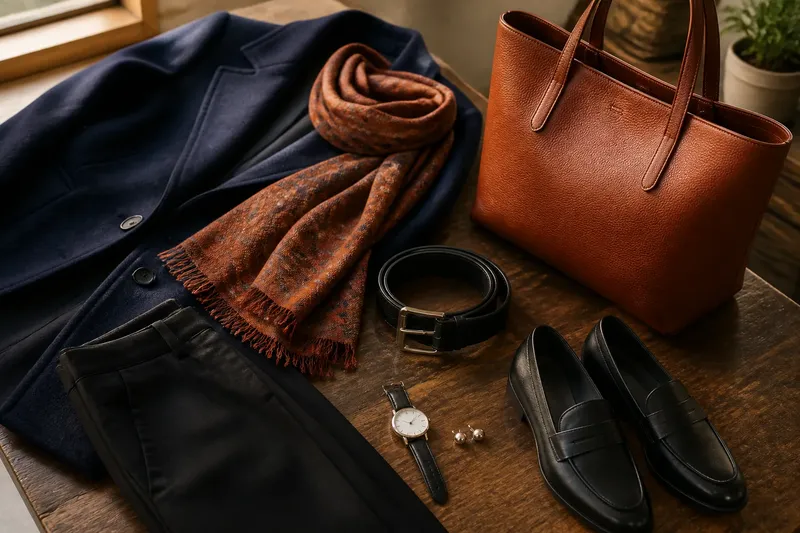
Say you have a loose navy coat, slim black trousers, and a large rust-colored tote. If the tote feels isolated, try a rust scarf with a modest pattern and leave the belt and shoes unchanged. The scarf gives the tote a color echo; if the outfit then feels crowded, remove the scarf and let the tote remain the single focal point.
Give small details room
Gold earrings, a silver watch, a patterned belt, colored glasses, and a bright bag can all be attractive pieces. Together, they may compete for attention. Pick the most distinctive item and quiet the nearby choices: bold glasses work with plain jewelry, while a patterned belt can sit with simpler shoes and a neutral bag.
Which accessories should match?
Do shoes and a bag need to match?
No. They can connect through a color family, finish, or shape without being the same shade. If they have no relationship to each other or the clothes, add a small color echo or choose one simpler piece.
Can gold and silver jewelry go together?
Yes, if the mix looks intentional. Repeat both metals in another detail, such as a two-tone watch with simple gold and silver rings, or keep one metal dominant and the other subtle.
How many accessory colors should I wear?
There is no fixed count. If the outfit feels busy, identify the strongest accessory color, then let other pieces connect through neutrals, texture, or one restrained accent.
What if an accessory is sentimental?
Keep it and build around it. Let a distinctive heirloom brooch or watch act as the focal point, and choose simpler accessories that support it rather than imitate it.
Check the outfit in order
Use this short review before changing several pieces at once. Start with the outfit as worn, including shoes and outerwear, and make one edit at a time so you can see what changes.
- Check the main accessory colors against the clothes; if one shade appears only once and feels isolated, add a small echo elsewhere or swap that accessory for a neutral.
- Check whether the leather, metal, and fabric finishes blend or create a clear contrast; if the contrast looks accidental, replace one piece with a closer finish or repeat the contrast once.
- Check which accessory first draws your eye from a few steps away; if it is not meant to lead, simplify or remove it, and if it is meant to lead, quiet the surrounding pieces.
- Check the largest and smallest accessory shapes together; if one looks out of scale with the rest, swap it for a piece with more comparable presence or leave it as the sole focal point.
- Check whether jewelry, a belt, glasses, or a patterned bag compete for attention; if several details stand out at once, keep the one you most want noticed and simplify the others.
- Check the outfit again after removing one accessory; if the combination looks clearer, leave that piece out, and if it loses a useful connection, restore it and remove a different item instead.
Imagine you are choosing an outfit for a casual dinner: a navy coat, black trousers, a rust tote, a black belt, silver earrings, and a glossy brown belt option. The tote is the only rust piece, and the glossy belt draws attention away from it. First, keep the black belt because it recedes against the trousers. Then add a rust scarf with a modest pattern to connect the tote to the coat. Looking again, suppose the silver earrings still compete with the scarf; swap them for plain studs. The resulting outfit has a rust focal point, a quiet belt, and simpler jewelry. If the scarf makes the coat feel crowded, remove it instead: the tote can lead without a matching partner.
When matching accessories still feels difficult, use the outfit check to identify the specific problem before reaching for another item. One clear connection, such as a shared color family or finish, is often enough; a deliberate contrast can supply the rest.