Why a Garment’s Grain Changes the Way It Hangs
Garment grain affects how fabric falls, twists, and settles. Learn to inspect seams and panels so you can judge a garment’s drape before choosing it.
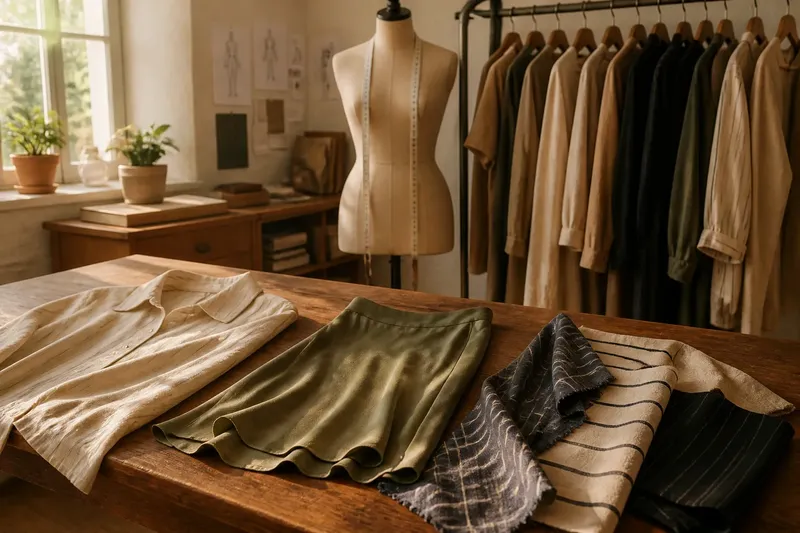
Why does one shirt fall cleanly from the shoulder while another seems to turn around the body? Garment grain is often part of the answer. It describes how the fabric’s threads run in relation to the garment, and that direction influences how panels hang, stretch, and respond to movement.
Grain is not a verdict on quality by itself. A maker may use different directions deliberately, and a garment can hang well while using more than one grain. The useful question is whether the fabric’s direction makes sense for the shape, and whether the seams and panels behave as though they belong together.
Reading fabric grain
Woven fabric has lengthwise threads, called warp, and crosswise threads, called weft. The warp generally runs parallel to the fabric’s selvage, the finished edge that does not unravel like a cut edge. The weft runs across the cloth, from one selvage toward the other. These directions are sometimes called lengthwise grain and crossgrain.
Many woven fabrics are less yielding along the lengthwise grain than across it. That is a tendency, not a law: weave, fiber, finish, and fabric construction all matter. Knit fabric behaves differently because its loops can stretch and recover in ways woven threads do not. A knit garment still has a direction, though, and its columns of stitches can help you see whether panels are aligned.
The bias is the diagonal direction between lengthwise and crosswise grain. Fabric cut on the bias tends to give more readily and can drape in soft curves. It can also lengthen or shift under its own weight. A narrow bias-cut facing and a whole flowing skirt are not the same design decision, but both rely on that extra movement.
Think of grain like the slats in a window blind. They can bend and move, but the direction in which they are arranged affects how the whole surface behaves. Cloth is more complex than a blind, fortunately for both cloth and blinds, yet the analogy helps explain why a small directional change can alter a garment’s fall.
Three grain choices
Most garments use more than one fabric direction somewhere, but their main panels often favor one of three approaches. Each has a different balance of stability, movement, and visual effect.
Lengthwise grain
Cutting a panel with its main vertical direction aligned to the lengthwise grain usually gives it a steadier hang. This approach suits tailored trousers, many jackets, and straight skirts, where a panel benefits from resisting unwanted lengthening or twisting. It is also a common choice for everyday woven shirts.
For the wearer, lengthwise grain can make a garment feel composed rather than fluid. It may be a sensible preference for clothes expected to keep a crisp outline through ordinary movement. It does not make a garment immune to wrinkling or distortion; it simply gives the panel a particular structural direction.
Crossgrain
Crossgrain means the panel’s prominent direction runs across the fabric rather than along its length. A maker may use it to place a stripe or motif differently, to work with a fabric’s character, or to fit a design and its available cloth. In some fabrics, crossgrain has more give than lengthwise grain, so the panel may respond differently at the body.
This approach suits garments where the effect is intentional and consistent, such as a panel that carries a horizontal stripe across the body. It can also appear in small sections without changing the overall behavior of the garment. Look for a reason in the design, not a rule that every crosswise panel is a flaw.
Bias grain
Bias-cut panels are useful when a designer wants fabric to follow curves or move with a soft, fluid swing. Dresses, skirts, scarves, and selected garment details may use the diagonal grain for that reason. The tradeoff is that bias fabric can settle unevenly if its weight pulls on the panel, particularly where the design leaves it unsupported.
Bias suits someone who likes movement and accepts a less rigid outline. A bias skirt may cling or ripple differently from a straight-grain skirt in the same cloth. The point is not to demand a perfectly still surface, but to decide whether the motion looks considered and whether neighboring panels support it.
Inspecting seams and panels
Start with the garment hanging freely, not stretched across your hands. Check whether its center lines, stripes, rib columns, or woven motifs run in a consistent direction where the design suggests they should. A pattern may deliberately change direction at a pocket, yoke, or side panel, so compare like parts rather than expecting every section to match.
Then look at seams. A seam joins two fabric edges, but it also reveals how those edges were positioned. If a side seam spirals toward the front or back, the garment may be cut off grain, may have shifted during sewing, or may be responding to fabric behavior. One seam alone cannot identify the cause. Check whether the opposite side behaves similarly and whether the garment’s overall outline remains balanced.
At the shoulder, compare the two sides and notice whether the sleeve seams fall in comparable positions. At a skirt or trouser leg, look for a vertical line that appears to wind around the body rather than descend straight. For a patterned cloth, see whether a stripe abruptly changes angle at a seam where no design change seems intended. These are observations, not automatic reasons to reject a garment.
Panels deserve the same attention. A panel is a distinct piece of fabric within the garment, such as a front, back, side insert, or yoke. Notice whether adjacent panels fall at similar angles and whether one section appears to pull against another. A deliberate bias panel can move differently from a straight-grain panel; the question is whether the seam joins them without a persistent kink, drag line, or lopsided hang.
- Check the garment on a hanger and, if possible, on your body. A hanger can reveal a twisting hem; wearing it shows whether the twist changes with movement.
- Follow a stripe, check, rib, or knit column across the front and back. Ask whether changes in direction look deliberate.
- Compare the left and right seams. Decide whether any difference is a design feature or makes the garment sit unevenly.
- Observe the hem while the garment hangs. A slanted edge can come from bias drape, an intentional shape, or uneven construction.
- Move naturally in the garment. Notice whether panels settle back into place or keep pulling in one direction.
Say you are considering a woven skirt with a straight front panel and angled side inserts. The starting point is a skirt whose side seams appear to drift forward on the hanger. You put it on, stand normally, and check the seam lines again. If the inserts settle into a smooth curve and the hem looks balanced, the angle may be part of the design; if one side continues to twist and pull the front panel, that is a concrete reason to choose another garment.
Which approach suits you?
Choose primarily lengthwise grain if you prefer a steady, tailored outline and want seams and panels to hold a relatively clear direction. This is often the easiest choice for trousers or a structured jacket, where a twisting line can distract from the intended shape.
Choose crossgrain details when their placement makes sense in the design and the garment sits evenly. A stripe deliberately running around a bodice may be the point. If the same stripe changes angle without a clear reason and the panel also pulls, the construction deserves closer attention.
Choose bias movement when you want a softer fall and are comfortable with fabric that responds more freely to gravity and motion. Check how the garment hangs at rest and when worn. A flowing panel need not be flat; it should look coherent with the rest of the garment.
The easiest decision is to compare the garment’s intended silhouette with what its seams and panels actually do. If the cut asks for a clean vertical line, watch for twisting. If it asks for fluid movement, allow some variation in the fall, while checking that the garment remains balanced. Care labels and manufacturer instructions should guide handling and laundering, since those can affect how a fabric settles.
Questions about grain?
Can you see grain in a finished garment?
Often you can infer it from stripes, checks, knit columns, and the way panels hang, though a plain fabric may offer few visible clues. Grain is easier to assess by comparing seams and the garment’s overall direction than by inspecting one isolated area.
Does a twisting seam always mean poor construction?
No. Fabric may have been cut off grain, but a seam can also twist because of the design, sewing, or the fabric’s own behavior. Check both sides and how the garment hangs on the body before deciding whether the effect is a problem for you.
Is bias-cut clothing supposed to look uneven?
Bias-cut fabric can fall in soft, shifting curves, so it need not look as rigid as a straight-grain panel. Persistent imbalance, a hem that appears skewed in a way the design does not support, or seams that pull may be reasons to inspect the garment more carefully.
Does grain matter in knitwear?
Yes, though the visible structure differs from woven cloth. Look at the direction of stitch columns, the alignment of stripes, and whether the body or sleeves appear to spiral. Stretch can disguise the direction temporarily, so view the garment at rest as well as while wearing it.
Choosing by the hang
Garment grain matters because direction shapes the way fabric falls, not because every panel must obey one universal alignment. For a quick choice, trace the lines your eye can follow, compare matching seams, and judge the garment on a hanger and on your body. The useful test is whether the fabric’s movement suits the silhouette you want. When it does, a quiet seam stays quiet, which is usually the best contribution it can make.